martes, 26 de febrero de 2019

zeroconditional

Image result for conditionals

As in all conditional sentences, the order of the clauses is not fixed. You may have to rearrange the pronouns and adjust punctuation when you change the order of the clauses, but the meaning is identical. In zero conditional sentences, you can replace "if" with "when", because both express general truths. The meaning will be unchanged.
When we are thinking about facts which are generally true, we use:

If + Present Simple, Present Simple

  • If you put water in the freezer, it becomes ice.
  • If you stand in the rain, you get wet.
  • If you heat ice, it melts.
You can see in the examples about the the condition always has the same result.
Notice how we use a comma after the first present simple tense clause.
We can also reverse the order and use:

Present Simple + If + Present Simple

  • You get wet if you stand in the rain.
  • Ice melts if you heat it.
  • I can't sleep if I drink coffee at night.
  • Plants die if you don't water them.
Notice how the comma is not necessary with this word order.

The Zero Conditional Structure

Take a look at this condition:
If I get lost,
This is not a complete sentence. There is some information missing. What happens if you get lost? What do you do? We need another clause to explain what happens.
Take a look at this result:
I ask for directions.
This is a complete sentence, but there is also some information missing. When do you ask for directions? Under what conditions do you ask for directions?
If I get lost, I ask for directions.
This is the easiest conditional sentence remember, because you use the present simple tense in both clauses of the sentence:
If + present simple, present simple
Now that you understand how to form the zero conditional, let’s focus on when to use it.

1. Habits

In English, use the present simple tense to talk about habits and daily routines:
I walk the dog every day.
I call my mother once a week.
I babysit my grandchildren every week.
 
You can also use the zero conditional sentence structure to talk about your habits, or things that you always do in certain situations or conditions.
Finish these sentences with what you do in these situations:
If I get sick, I …
If I miss the train, I …
If I don’t sleep well, I …
If I drink, I …
If it’s hot, I …
If it snows, I …
Remember: You are thinking about your habits, not a specific situation that is happening today or that will possibly happen tomorrow.
 
Now, take a look at these sentences. Do you do these things? When do you do these things?
I stay home from work.
I drive to work.
I am cranky in the morning.
I never drive.
I go to the beach.
I shovel the driveway.
 
These things are connected. Let’s put them together in the zero conditional sentence structure.
If this event or condition happens, this is what I do.
If I get sick, I stay home from work.
If I miss the train, I drive to work.
If I don’t sleep well, I am cranky in the morning.
If I drink, I never drive.
If it’s hot, I go to the beach.
If it snows, I shovel the driveway.
EXAMPLES
  • If you heat ice, it melts.
  • Ice melts if you heat it.
  • When you heat ice, it melts.
  • Ice melts when you heat it.
  • If it rains, the grass gets wet.
  • The grass gets wet if it rains.
  • When it rains, the grass gets wet.
  • The grass gets wet when it rains.

The zero conditional is also often used to give instructions, using the imperative in the main clause.

EXAMPLES
  • If Bill phones, tell him to meet me at the cinema.
  • Ask Pete if you're not sure what to do.
  • If you want to come, call me before 5:00.
  • Meet me here if we get separated.


Complete the zero conditional sentences with the verb in brackets. Use contractions where possible.
it turns I go they don't have he's comes you aren't I don't know we don't do
  1. If you press that button, the light(come) on.score
  2. It's easier to sleep if(you / not / be) stressed.score
  3. The teacher gets angry if(we / not / work) hard.score
  4. If(I / go) on a boat, I always feel sick.score
  5. His mother gets annoyed if(he / be) late.score
  6. If(I / not / know) a word, I look in my dictionary.score
  7. They play football if(they / not / have) any homework.score
  8. If you freeze water,(it / turn) to ice.

martes, 12 de febrero de 2019

could


English exercise "Could/Couldn't"


1. When I was young, I  play the guitar: it was too difficult for me!

2. Her grandmother was bilingual: she  speak both English and Spanish.

3. Yesterday, Peter  do that exercise alone. So, he called me for help.

4. In 1950, people  use mobile phones.

5. When his mother was young, she  skate but she can't do it any longer.

6. We  open the door: it was locked from the inside!

7. In 1900, people  watch TV.

8. Mary's grandfather  play chess and he was the best!

9. In 1945, people  play video games.

10. But they  play chess!

11. Peter  play tennis last Monday: he had broken his arm!

12. When Ann was a teenager, she  watch a horror film: it was too frightening for her!

13. Last Sunday, we  take any photos in the museum: it was forbidden.

14. Mozart  play the piano when he was 5.


Choose the correct answer.
  1. you at home last night?score
  2. We send you an email because our computer was broken.score
  3. The concert very good. The singers were fantastic.score
  4. I go to the beach on Sunday because I was at work.score
  5. They on holiday last week.score
  6. Mike ill last week, but he's okay now.score
  7. your brothers skateboard when they were six?score
  8. He when he was four.


Use the correct form of "can" to complete each of these sentences. Use contractions where possible.

1. I  sleep last night. It was so hot!
2. When I was five or six, I  do a handstand, but I now.
3. My late grandfather  speak French and my father say a few words of Spanish. I  speak anything but English.
4. We're having a dinner party next Saturday, but Roger  come.
5. When I met Darren last year, he  swim. He was terrified of the water. Now he  swim like a fish!
6. I  finish my lunch today. I just wasn't hungry at all.
7. There are so many different ice creams to choose from. I  decide. You choose for me.

8. I  find Ben and then I found him in the garden. Now I find him again. He keeps disappearing!


martes, 5 de febrero de 2019

usedtowoud

  1. I didn’tlive in this city.score
  2. Weoften go on holiday.score
  3. When I was a child, wehave a dog.score
  4. Sheas a teacher for many years.score
  5. As a student, he neverhave any money.score
  6. Did youlike playing football at school?score
  7. There nevera coffee shop here.score
  8. My dadalways read to me before bed.score


1. Do you remember how your Uncle David  sit in that chair and smoke those disgusting cigars.
2. Your mother  have a Yorkshire Terrier when she was a young girl, didn't she?
3. For years, they  go on holiday to the Rockies, but then it became very fashionable and, hence, expensive.
4. Years ago, I  write a diary every day but then I got bored with doing it and I stopped. Maybe it was my life that was boring!
5. At the start of their marriage, they  be very happy - but then it all went wrong!
6. You  spell so well. Whatever happened?
7. When I was five, I  be able to do incredible gymnastics. Now I can't even touch my toes.
8. Before getting my driving licence, I  ride a bicycle everywhere.


miércoles, 30 de enero de 2019

planevaluacion


              Image result for 2nd semester             Image result for evaluation plan


please download the evaluation plan for second semester


                ------->  click here


Image result for aviso importante

A todos los alumnos que presentaran saberes previos  en todos los niveles se les comunica que dicho examen se llevara acabo en la primera semana se febrero debido que son varios exámenes en comparacion con otras asignaturas por lo cual se les invita a asistir a todas sus clases con la finalidad de realizar dichos examanes a tiempo


miércoles, 21 de marzo de 2018

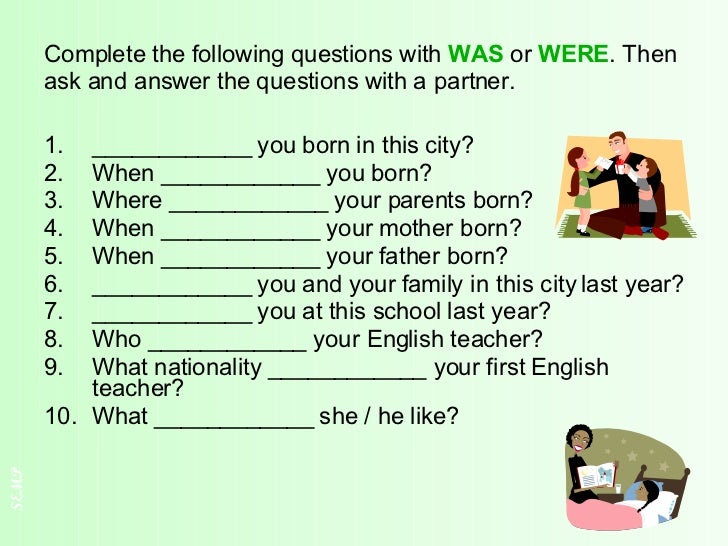
simple past / was / were

SIMPLE PAST 
Image result for simple past was were
Use was or were. Choose from the drop down menu.
  1. I  in Canberra last spring.
  2. We  at school last Saturday.
  3. Tina  at home yesterday.
  4. He  happy.
  5. Robert and Stan  Garry's friends.
  6. You  very busy on Friday.
  7. They  in front of the supermarket.
  8. I  in the museum.
  9. She  in South Africa last month.
  10. Jessica and Kimberly  late for school.
Use was not or were not. Choose from the drop down menu.

  1. They  ill.
  2. You  tired.
  3. The children  quiet.
  4. Max  in Helsinki last week.
  5. She  home for dinner.
  6. The water  cold.
  7. There  a good film on TV yesterday.
  8. We  in Brazil last winter.
  9. Betty and Florence  at school this morning.
  10. I  happy when I heard about the accident.

download the next exercise and do it on your notebook.

PRESS  HERE


Image result for simple past was were

miércoles, 14 de marzo de 2018

S I M P L E P A S T

Hay muchas maneras de hablar del pasado en inglés, pero el pasado simple es la forma más común. El pasado simple en inglés es equivalente al pretérito imperfecto y pretérito indefinido del español. Usamos el pasado simple para acciones completas en el pasado. El período de tiempo de estas acciones no es importante como en el español. En el pasado simple hay verbos regulares y verbos irregulares.


Grammatical Rules (Reglas gramaticales)


Form (Forma)

Para formar el pasado simple con verbos regulares, usamos el infinitivo y añadimos la terminación “-ed”. La forma es la misma para todas las personas (I, you, he, she, it, we, they).
Ejemplos:
 want →   wanted
 learn →   learned
 stay →   stayed
 walk →   walked
 show →   showed
Excepciones:
1. Para verbos que terminan en una “e”, sólo añadimos “-d”.
Ejemplos:
 change →   changed
 believe →   believed
2. Si el verbo termina en una vocal corta y una consonante (excepto “y” o “w”), doblamos la consonante final.
Ejemplos:
 stop →   stopped
 commit →   committed
3. Con verbos que terminan en una consonante y una “y”, se cambia la “y” por una “i”.
Ejemplos:
 study →   studied
 try →   tried

Pronunciation (Pronunciación)

Pronunciamos la terminación “-ed” de forma diferente dependiendo de la letra que va al final del infinitivo. En general la “e” es muda.
1. Con los infinitivos que terminan en “p”, “f”, “k” o “s” (consonantes sordas, excepto “t”) pronunciamos la terminación “-ed” como una “t”.
Ejemplos:
 looked[lukt]
 kissed[kisst]

2. Con los infinitivos que terminan en “b”, “g”, “l”, “m”, “n”, “v”, “z” (consonantes sonoras, excepto “d”) o una vocal, pronunciamos sólo la “d”.
Ejemplos:
 yelled[jeld]
 cleaned[klind]
3. Con los infinitivos que terminan en “d” o “t”, pronunciamos la “e” como una “i”.
Ejemplos:
 ended[endid]
 waited[weitid]

Structure (Estructura)

1. Affirmative Sentences (Frases afirmativas)
Sujeto + verbo principal…
Ejemplos:
 She was a doctor.(Era doctora.)
 The keys were in the drawer.(Las llaves estaban en el cajón.)
 I wanted to dance.(Quería bailar.)
 They learned English.(Aprendieron inglés.)
 We believed him.(Le creímos.)
 I bought a blue car.(Compré un coche azul.)
2. Negative Sentences (Frases negativas)
To be:
Sujeto + “to be” + “not”…
Ejemplos:
 She wasn’t a doctor.(Ella no era doctora.)
 The keys weren’t in the drawer.(Las llaves no estaban en el cajón.)
Nota: El verbo “to have got”, que en el presente simple sigue las mismas reglas que el verbo “to be”, no puede ser utilizado en el pasado. Para indicar la posesión en el pasado, usamos el verbo “to have”.
Todos los verbos demás:
Sujeto + verbo auxiliar (to do) + “not” + verbo principal (en infinitivo)…
Ejemplos:
 I didn’t want to dance.(No quería bailar.)
 They didn’t learn English.(No aprendieron inglés)
 We didn’t believe him.(No le creímos.)
 I didn’t buy a blue car.(No compré un coche azul.)
Nota: En frases negativas, el verbo auxiliar va en pasado (“did”) y el verbo principal se queda en el infinitivo.
3. Interrogative Sentences (Frases interrogativas)
To be:
“To be” + sujeto…?
Ejemplos:
 Was she a doctor?(¿Era doctora?)
 Were the keys in the drawer?(¿Estaban las llaves en el cajón?)
Todos los demás verbos:
Verbo auxiliar (to do) + sujeto + verbo principal (en infinitivo)…?
Ejemplos
 Did you want to dance?(¿Querías bailar?)
 Did they learn English?(¿Aprendieron inglés?)
 Did you believe him?(¿Le creíste?)
 Did you buy a blue car?(¿Compraste un coche azul?)
Nota: Al igual que en las frases negativas, el verbo auxiliar va en pasado (“did”) y el verbo principal se queda en el infinitivo.

Uses (Usos)

1. El pasado simple se utiliza para hablar de una acción concreta que comenzó y acabó en el pasado. En este caso equivale al pretérito indefinido español. Generalmente, lo usamos con adverbios de tiempo como “last year”, “yesterday”, “last night”…
Ejemplos:
 Tom stayed at home last night.(Tom se quedó en casa anoche.)
 Kate worked last Saturday.(Kate trabajó el sábado pasado.)
 I didn’t go to the party yesterday.(No fui a la fiesta ayer.)
 Did they walk to school this morning?(¿Han andado a la escuela esta mañana?)
2. Se usa el pasado simple para un serie de acciones en el pasado.
Ejemplos:
 I received the good news and immediately called my husband.(Recibí la buena noticia y llamé de inmediato a mi marido.)
 He studied for an hour in the morning, worked all afternoon and didn’t returnhome until 10 at night.(Estudió durante una hora por la mañana, trabajó toda la tarde y no regresó a casa hasta las 10 de la noche.)
3. También lo usamos para acciones repetidas o habituales en el pasado, como se usa el pretérito imperfecto español.
Ejemplos:
 We always traveled to Cancun for vacation when we were young.(Siempre viajábamos a Cancun durante las vacaciones cuando éramos jóvenes.)
 He walked 5 kilometers every day to work.(Caminaba 5 kilómetros hasta el trabajo cada día.)
4. Lo usamos para narraciones o acciones de períodos de largo tiempo en el pasado, como el pretérito imperfecto español.
Ejemplos:
 I worked for many years in a museum.(Trabajaba en un museo durante muchos años.)
 She didn’t eat meat for years.(No comía carne durante años.)
5. Se utiliza para hablar de generalidades o hechos del pasado.
Ejemplos:
 The Aztec lived in Mexico.(Los aztecas vivían en México)
 I played the guitar when I was a child.(Tocaba la guitarra cuando era niño.)